Major Geopolitical Changes Influencing International Relations Today
International relations in the twenty-first century are experiencing significant transformation due to evolving geopolitical dynamics. Political tensions, economic competition, technological innovation, and shifting alliances are reshaping how countries interact with each other. The global system that emerged after the Cold War is gradually being replaced by a more complex and multipolar world order where several powerful nations and regional blocs influence global politics.
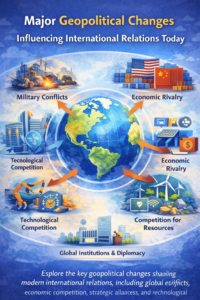
Today, conflicts, economic competition, and strategic partnerships are redefining diplomacy and global cooperation. Issues such as military conflicts, trade disputes, competition for technological dominance, and the race for natural resources have become central to global politics. These developments influence not only national security but also economic stability, international cooperation, and global governance.
Understanding these geopolitical shifts is essential for analyzing modern international relations. Governments, international organizations, and policymakers must adapt their strategies to manage conflicts, strengthen alliances, and address global challenges in an increasingly interconnected world.
Rising Military Conflicts and Regional Instability
Military conflicts and regional tensions remain one of the most significant factors influencing international relations today. Several regions of the world are experiencing geopolitical instability due to ongoing conflicts and security disputes.
One of the major developments in recent years has been escalating tensions in the Middle East involving the United States, Israel, and Iran. Large-scale military operations targeting Iranian military infrastructure have intensified regional instability and increased the risk of wider conflict. These confrontations have affected global security and energy markets, especially because the region plays a critical role in global oil supply.
Similarly, the ongoing war between Russia and Ukraine continues to influence relations between major powers and has led to sanctions, military support agreements, and diplomatic tensions between Western countries and Russia. These conflicts demonstrate how regional wars can quickly develop into global geopolitical issues involving multiple international actors.
The persistence of such conflicts highlights the importance of diplomacy, peace negotiations, and international cooperation in maintaining global stability.
Emergence of a Multipolar World Order
Another major geopolitical shift shaping international relations is the gradual transition from a unipolar to a multipolar world order. After the end of the Cold War, the United States emerged as the dominant global power. However, the global balance of power is now changing as several emerging economies and regional powers increase their influence.
Countries such as China, India, Brazil, and other developing nations are playing increasingly important roles in global governance and international diplomacy. Economic growth, technological development, and military modernization have strengthened their global influence.
International organizations and multilateral platforms are also evolving to reflect this shift. For example, global forums that promote cooperation among emerging economies are focusing on strengthening cooperation in areas such as trade, investment, and global governance reforms.
This transformation toward a multipolar system has created new opportunities for international cooperation but has also increased competition among major powers seeking to expand their influence.
Strategic Alliances and Security Partnerships
Strategic alliances remain a central feature of international relations, particularly in the areas of defense and security. Countries often form alliances to strengthen their collective security and respond to emerging threats.
Defense organizations such as NATO continue to play a crucial role in coordinating military strategies among member states. Recent international security summits have emphasized increased defense spending and stronger military cooperation among allied nations.
At the same time, new security partnerships are emerging in response to evolving geopolitical challenges. Countries are forming regional alliances to address issues such as terrorism, cyber threats, and maritime security.
These partnerships demonstrate that international relations are increasingly shaped by strategic cooperation among groups of countries rather than isolated national policies. Alliances help countries maintain stability and respond collectively to global security challenges.
Economic Competition and Trade Rivalries
Economic competition has become another key driver of geopolitical change. International trade policies, tariffs, and economic sanctions increasingly influence diplomatic relations between countries.
Major economies are using trade policies to protect domestic industries and strengthen their economic positions. This includes the introduction of tariffs, export restrictions, and policies encouraging domestic production. Such measures can reshape global supply chains and alter trade relationships between nations.
For example, shifting global supply chains have encouraged companies to diversify production locations and reduce dependence on specific countries. This process has created new economic opportunities for emerging markets while also intensifying economic rivalry among major powers.
Economic competition is therefore closely connected with geopolitical strategy, as countries use trade policies and financial systems to expand their influence and protect national interests.
Technological Competition and Digital Geopolitics
Technology has become a crucial element of geopolitical competition in the modern world. Nations are increasingly competing for leadership in areas such as artificial intelligence, cybersecurity, and advanced digital infrastructure.
Artificial intelligence and advanced computing technologies are now considered strategic national assets. Governments view technological leadership as essential for economic growth, military capabilities, and global influence.
This technological competition has also contributed to the emergence of digital geopolitics, where countries regulate data flows, control digital infrastructure, and invest heavily in research and development. Cybersecurity threats and cyber warfare have further intensified this competition.
As digital technologies continue to evolve, they will play an even greater role in shaping global power dynamics and international cooperation.
Competition for Natural Resources and Critical Minerals
Access to natural resources has always been a major factor in international relations, but its importance has increased in recent years. Countries are competing for access to critical minerals, rare earth elements, and energy resources needed for modern technologies and defense systems.
These resources are essential for producing electric vehicles, renewable energy systems, advanced electronics, and military equipment. As global demand for these materials increases, governments are developing strategic partnerships and agreements to secure stable supply chains.
International agreements focusing on critical minerals highlight the growing geopolitical importance of these resources. Competition for resource control can influence diplomatic relationships, trade policies, and global economic strategies.
This resource competition is expected to shape international relations for decades as nations seek to secure the materials needed for technological and industrial development.
The Role of Global Institutions and Diplomacy
International institutions continue to play an important role in managing geopolitical tensions and promoting cooperation among nations. Organizations such as the United Nations and regional diplomatic forums provide platforms for dialogue, conflict resolution, and policy coordination.
However, geopolitical divisions among major powers sometimes make collective decision-making more difficult. Differences in national interests can lead to disagreements within international institutions, limiting their ability to respond quickly to global crises.
Despite these challenges, diplomacy remains essential for addressing global issues such as climate change, security conflicts, economic stability, and humanitarian crises. International cooperation and diplomatic engagement help maintain stability in an increasingly complex geopolitical environment.
Conclusion
Major geopolitical changes are reshaping international relations in the modern world. Military conflicts, economic competition, technological rivalry, and shifting alliances are transforming how nations interact and cooperate on global issues.
The emergence of a multipolar world order has increased the number of influential actors in global politics, creating both opportunities for cooperation and challenges related to competition and conflict. At the same time, technological innovation and resource competition are redefining strategic priorities for many countries.
As these geopolitical dynamics continue to evolve, diplomacy, strategic partnerships, and international cooperation will remain essential for maintaining global stability. Understanding these changes helps policymakers, researchers, and global leaders navigate the complex landscape of modern international relations.
Read more : engahmedgamal.com