Blog
artificial intelligence trends, digital economy growth, economic trends 2026, future of the world, future workforce trends, global connectivity, global innovation trends, global technology trends, global trends 2026, healthcare technology trends, renewable energy future, smart cities development, sustainable development trends, world transformation trends
Yuvi
Global Trends in 2026 Shaping the Future of the World
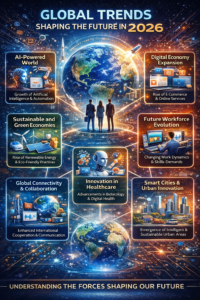
The world is changing at an unprecedented pace as technological innovation, economic shifts, environmental challenges, and social transformations influence how societies function. By 2026, several global trends are shaping the future of industries, governments, and communities around the world. These trends are not isolated developments but interconnected forces that collectively define the direction of global progress.
Advancements in technology, growing environmental awareness, digital connectivity, and evolving economic structures are transforming how people live and work. Governments, businesses, and individuals are adapting to these changes in order to remain competitive and resilient in a rapidly evolving global environment. Understanding these emerging trends is essential for preparing for the future and making informed decisions.
The following global trends highlight the key developments expected to shape the world in 2026 and beyond.
Table of Contents
ToggleRapid Advancement of Artificial Intelligence and Automation
Artificial intelligence and automation continue to expand across industries, becoming one of the most influential technological trends shaping the global economy. In 2026, AI is increasingly integrated into sectors such as healthcare, finance, manufacturing, logistics, and customer service. Businesses are using AI-powered tools to analyze large amounts of data, automate repetitive tasks, and improve operational efficiency.
Automation technologies are transforming the workforce by reducing manual processes while increasing productivity. While some traditional jobs are being replaced by automated systems, new roles are emerging in areas such as data science, AI management, and digital innovation. As organizations adopt intelligent technologies, employees are required to develop new skills to work alongside advanced systems.
This technological shift is not only improving productivity but also enabling smarter decision-making. Governments and businesses worldwide are investing heavily in AI research and development to stay competitive in the global digital economy.
Transition Toward Sustainable and Green Economies
Environmental sustainability has become a central focus of global development strategies. In 2026, countries and corporations are increasingly prioritizing policies and initiatives aimed at reducing carbon emissions and promoting renewable energy sources. Climate change concerns have accelerated investments in green technologies such as solar power, wind energy, electric vehicles, and energy-efficient infrastructure.
Governments are implementing regulations and incentives that encourage businesses to adopt environmentally responsible practices. Companies are also recognizing that sustainability is not only an ethical responsibility but also a strategic advantage in the modern marketplace. Consumers are increasingly supporting brands that demonstrate commitment to environmental protection.
The transition toward green economies is creating new industries and employment opportunities in renewable energy, sustainable manufacturing, and environmental management. As the world continues to address climate challenges, sustainability will remain a defining global trend.
Expansion of the Digital Economy
The digital economy is expanding rapidly as internet connectivity, digital platforms, and online services become integral parts of daily life. By 2026, e-commerce, digital banking, remote work technologies, and online entertainment have significantly transformed economic activities around the world. Businesses are increasingly relying on digital platforms to reach customers and deliver services efficiently.
Digital transformation allows companies to operate across borders and access global markets more easily than ever before. Small businesses and entrepreneurs benefit from online platforms that provide tools for marketing, sales, and customer engagement. At the same time, digital payment systems and financial technologies are making transactions faster and more secure.
As digital infrastructure continues to improve, the digital economy is expected to drive economic growth and innovation in both developed and emerging markets. Governments are investing in digital connectivity to ensure that their populations can participate in the global digital ecosystem.
Evolution of the Global Workforce
The nature of work is evolving as technology, remote work capabilities, and shifting economic priorities reshape employment patterns. In 2026, hybrid work models that combine remote and in-office work have become increasingly common across many industries. Digital communication tools allow employees to collaborate effectively regardless of physical location.
The global workforce is also experiencing a growing demand for specialized skills, particularly in technology, data analysis, cybersecurity, and digital marketing. Continuous learning and professional development are becoming essential for workers who want to remain competitive in the job market.
Organizations are focusing more on flexible work environments that support employee well-being and productivity. This shift in workplace culture reflects broader changes in how people balance professional responsibilities with personal life.
Innovation in Healthcare and Biotechnology
Healthcare systems around the world are experiencing rapid innovation due to advancements in biotechnology, digital health technologies, and medical research. In 2026, telemedicine services allow patients to consult healthcare professionals remotely, improving access to medical care in many regions. Digital health platforms enable patients to monitor their health using wearable devices and mobile applications.
Biotechnology research is contributing to the development of advanced medical treatments and personalized healthcare solutions. Scientists are exploring new therapies for complex diseases while improving diagnostic tools that detect health conditions earlier and more accurately.
These innovations are improving patient outcomes and making healthcare services more efficient. As healthcare technology continues to evolve, it has the potential to significantly enhance global health systems and increase life expectancy.
Increasing Global Connectivity and Collaboration
The modern world is more interconnected than ever before due to advancements in communication technologies and global networks. In 2026, international collaboration is playing a crucial role in addressing global challenges such as climate change, economic stability, and public health. Governments, organizations, and researchers are working together to develop solutions that benefit the global community.
Digital communication platforms allow individuals and businesses to collaborate across continents in real time. International partnerships in science, technology, education, and commerce are fostering innovation and knowledge sharing. This interconnected environment encourages diverse perspectives and collective problem-solving.
Global connectivity also enables cultural exchange and greater understanding among different societies. As communication technologies continue to evolve, collaboration across borders will remain an important driver of global progress.
Growth of Smart Cities and Urban Innovation
Urban areas are expanding rapidly, leading governments to invest in smart city technologies that improve infrastructure and public services. Smart cities use advanced technologies such as sensors, data analytics, and connected systems to manage transportation, energy consumption, and urban planning more efficiently.
In 2026, cities are implementing intelligent transportation systems, smart energy grids, and digital public services that enhance the quality of urban living. These innovations help reduce traffic congestion, optimize energy use, and improve safety in densely populated areas.
Smart city development also supports sustainable urban growth by integrating environmental considerations into city planning. As urban populations continue to increase, smart technologies will play an essential role in creating efficient and livable cities.
Conclusion
Global trends in 2026 reflect a world that is increasingly shaped by technology, sustainability, and interconnected economies. Artificial intelligence, digital transformation, environmental initiatives, and healthcare innovations are influencing how societies develop and respond to emerging challenges.
At the same time, changes in the global workforce, urban development, and international collaboration demonstrate the importance of adaptability in a rapidly evolving world. Governments, businesses, and individuals must remain open to innovation and continuous learning in order to thrive in this dynamic environment.
The future will be defined by how effectively societies manage these global trends and use them to create opportunities for economic growth, social progress, and environmental sustainability. By understanding these developments, the world can move toward a more resilient, innovative, and inclusive future.
Read more : whitesystemz.com
Tag
artificial intelligence trends digital economy growth economic trends 2026 future of the world future workforce trends global connectivity global innovation trends global technology trends global trends 2026 healthcare technology trends renewable energy future smart cities development sustainable development trends world transformation trends